
Before you confirm
Smart Shopping: cautions worth a minute before you pay
The categories where Lolobuy's own rules add extra steps — sizing, customisation, gifts, pre-orders — and why skipping them tends to cost more later.
The five flags
What Lolobuy itself asks you to confirm before buying
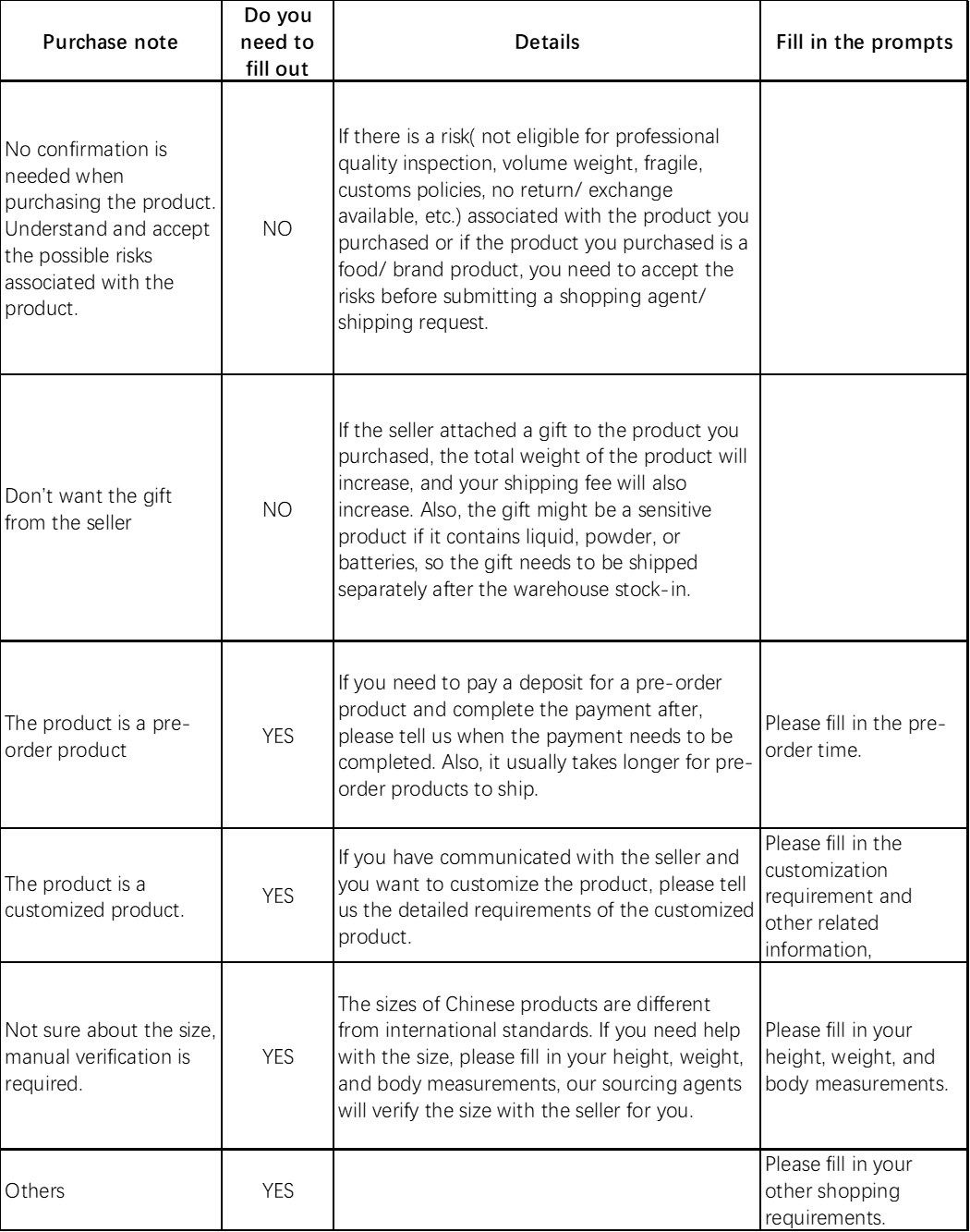
Lolobuy's own purchase-note table flags five situations where extra detail up front saves a problem later: accepting the stated risks on a product (volumetric weight, fragility, no-return eligibility, or restricted-content flags like liquid or battery); declining an unwanted gift a seller attaches, since it adds weight and may need to ship separately; confirming a payment-completion timeframe for pre-order items; specifying customisation requirements in full; and submitting height, weight and body measurements if a size needs manual verification against Chinese sizing, which commonly differs from international standards.
Two specific traps
Sizing and bundled extras
Sizing, specifically
Chinese sizing conventions frequently do not line up with US, UK or EU size labels on the same garment type. Lolobuy's sourcing agents will manually verify a size against a seller's own chart if you provide height, weight and body measurements — skipping that step and ordering by label alone is one of the more common sources of a return.
Restricted and bundled items
Liquids, powders and battery-adjacent goods route onto specific sensitive shipping lines at a higher price and a longer transit window — see Shipping & Storage. An unrequested gift bundled into an order can quietly add one of these flags to an otherwise simple parcel, which is why Lolobuy's own form lets you decline it up front.
Reading the fine print
Why the cheapest listing on a shelf isn't automatically the best one
Discounted-for-flaws listings deserve a second look
Lolobuy's own defect-handling reference includes a real example of a listing selling a pack of socks cheaply with small print disclosing the stock “may have small flaws.” That kind of listing is not a scam — it is accurately described, if you read past the headline price — but it is also not a candidate for a return once a QC photo confirms exactly the flaw the listing already disclosed. Read a listing's fine print the same way you would read the specification menu: fully, before confirming.
When a lower price signals a trade-off, not a bargain
A price well below comparable listings in the same category is usually explained somewhere on the page — a flaw disclosure, a different material, a smaller size run, a bundle that excludes an accessory shown in the photo. Treat an unusually low price as a prompt to read more carefully, not as something to act on before a competing buyer does.